


The challenge
This global enterprise software leader runs cloud applications for enterprises across many industries. The Kubernetes estate was significantly overprovisioned, and the team needed waste identification, observability, rightsizing, and automation in one solution, not four.
The deeper requirement was AI-native access to optimization intelligence. The customer wanted a way for engineers to surface container cost savings, node cost savings, cost allocation, root cause analysis, and risk and trend identification without spending half their week assembling reports. At this scale, manual analysis was never going to keep up.
The solution
The customer connected the team to Kubex’s AI layer through MCP, and adopted a working prompt library for the in-product AI agent. The same team now uses the agent to ask the questions that used to take hours to answer.
For cost and savings, the agent surfaces total waste, top clusters and namespaces, savings opportunities by group, immediate versus long-term savings, top containers to optimize, top node groups by waste, optimal node types per node group, and the most expensive containers across allocation.
For risk and root cause analysis, the agent surfaces current risks (OOM kills, node saturation, CPU throttling, HPA resource saturation), resource issues affecting specific services, automation event impact and change detection, predictive risk trends including HPA resources and nodes trending toward saturation, and anomaly detection.
The team is asking the questions in plain English. The agent is returning the answers in seconds.
The results
- Conversational, AI-led access to cost optimization, node sizing, cost allocation, root cause analysis, risk identification, and anomaly detection across the Kubernetes estate
- Engineers no longer assembling cost or risk reports manually; the AI agent returns the same analysis on demand
- A working prompt library that turns specialist Kubernetes optimization expertise into accessible team capability
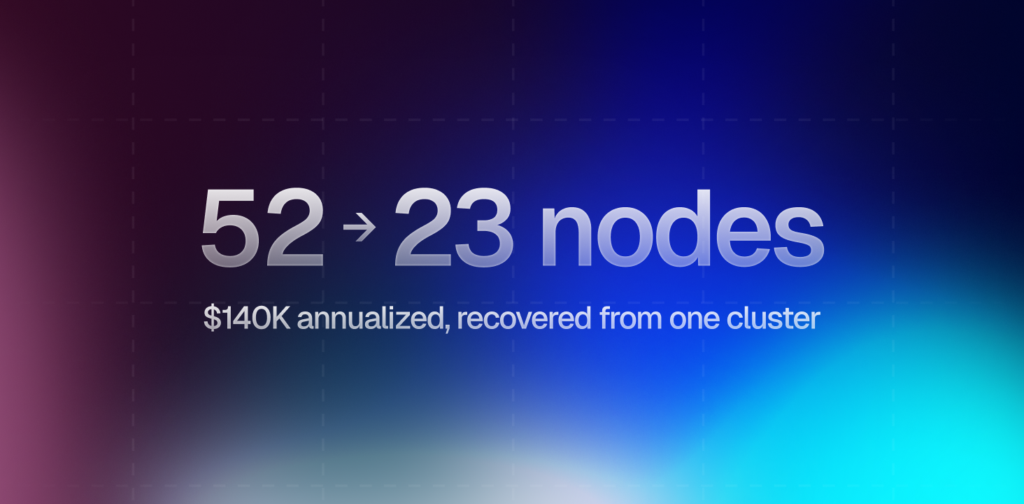
- Real savings underneath the AI story: $140K annualized recovered from a single cluster (52 nodes to 23) during the broader Kubex engagement
- Foundation in place to extend the same AI-led model to additional business units across the enterprise


