



The challenge
This global leader in cloud-managed networking serves organizations worldwide. Behind that product sits a large Kubernetes estate split across on-prem bare metal and AWS EKS. The team could not see all of it clearly, and could not tell where the waste was.
The core problem was provisioning. Kubernetes resources were sized from a single template built for the largest application, so every workload inherited the same oversized footprint whether it needed it or not. Telemetry showed how far off that ran: across the estate, 84 percent of requested CPU and 66 percent of requested memory was never used.
Capacity planning was just as hard. The team had little visibility into growth, no reliable forecast, and two problems to solve at once: use the capacity they already owned on-prem, and cut operating expense on EKS.
The solution
Kubex gave the team one view across both environments. On-prem bare metal Kubernetes and AWS EKS, in a single plane of glass, measured against real utilization rather than a one-size template.
On optimization, the team deployed Kubex, with automation policies tuned to each application’s requirements. Kubex autonomously rightsizes CPU and memory across production, inside the guardrails the team sets. It resizes; it never shuts anything down.
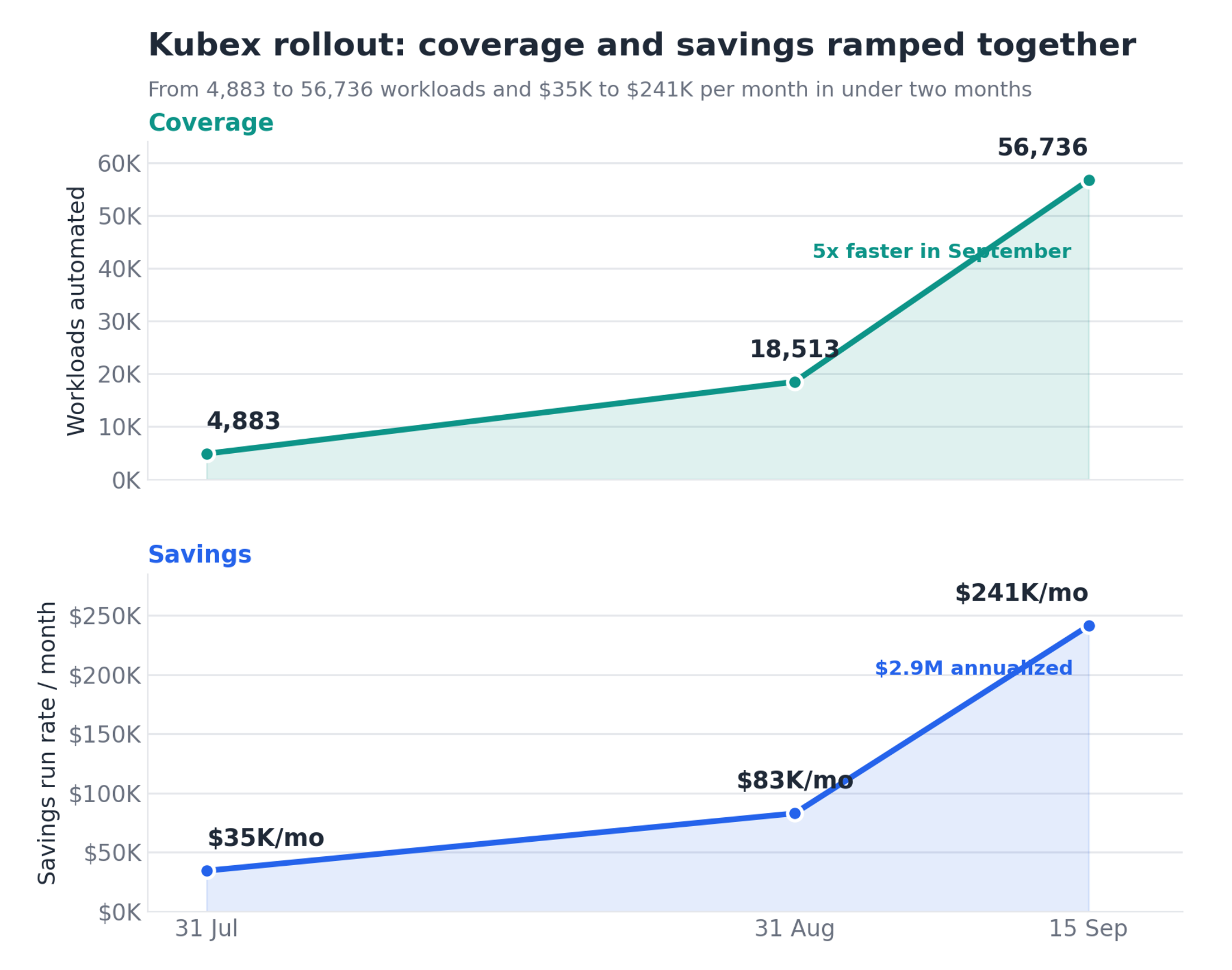
The rollout followed a phased plan, beginning on a first wave of nine clusters and expanding in batches of roughly 25 percent of the estate. By September 2026 it covered 11 clusters and tens of thousands of workloads, running at about five times its mid-year pace.
On capacity planning, the team uses Kubex analysis of historical utilization to predict what they will actually need, on-prem and in the cloud. Instead of buying ahead of demand, they buy against a forecast.
The results
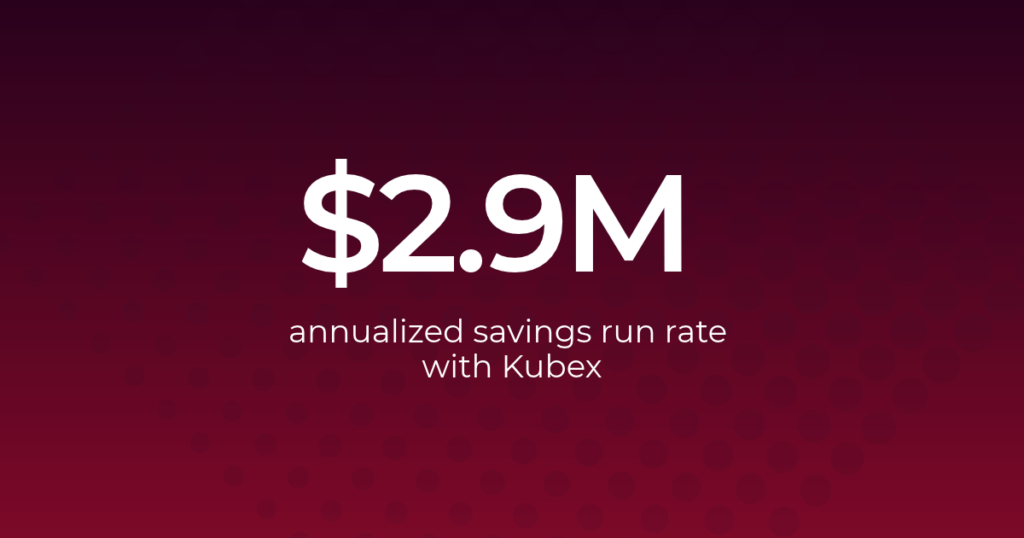
- Verified savings run rate of $2.9M annualized as of September 2026, or $241,331 per month
- Tens of thousands of workloads automated across 11 clusters, reclaiming roughly 12,300 CPU cores and 31 TiB of memory, about 139 nodes worth of headroom
- Split across both environments: $1.63M annualized in the cloud, $1.27M annualized on-prem
- Value captured in both environments: a lower cloud bill as node counts fall, and avoided hardware purchase on-prem
- A JVM modernization caught early: Kubex flagged the rising memory consumption, so the team isolated the cause instead of approving more memory for every affected app
- One pane of glass across on-prem bare metal Kubernetes and AWS EKS, with autonomous rightsizing governed by application-level policies
In their words
“We’re saving a lot of money by rolling out Kubex. It’s an effort that is worth doing. These are just real numbers that we see coming forward.”
Senior infrastructure leader, global cloud-managed networking company


