


The challenge
Like many enterprises on their FinOps journey, FactSet struggled to translate cloud optimization insights into action. While the FinOps team regularly identified savings opportunities and surfaced them through reports and dashboards, those insights often failed to reach engineering teams in a meaningful way. For Hitesh Chitalia, Director of Cloud Optimization at FactSet, this created a persistent challenge: valuable right-sizing recommendations were being overlooked because engineers rarely engaged with the systems where those recommendations were published.
As Chitalia observed, the issue was not the quality of the data, but its distance from engineers’ day-to-day workflows. FactSet’s approach shifted from requiring engineers to seek out optimization opportunities to delivering those opportunities directly within the tools and communications channels they already use. By enriching recommendations retrieved from the Kubex MCP with billing information, engineers can assess and determine the appropriate course of action. Whether executing the recommendation, delegating it to an automated agent, or deferring it for later review, teams can make informed decisions without leaving their existing workflow.
The solution
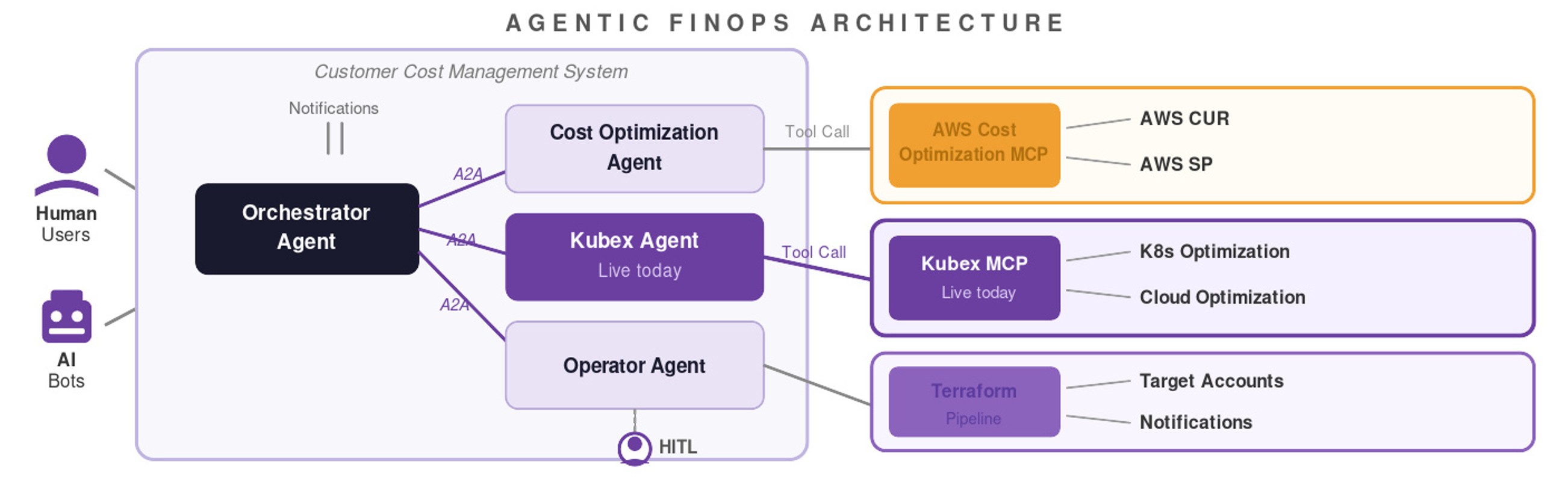
FactSet’s cloud FinOps agent is built on AWS Bedrock AgentCore with LangGraph orchestration, coordinated through Agent-to-Agent (A2A) protocol, with Terraform managing the underlying infrastructure. The agent accesses to Kubex MCP for right-sizing recommendations across ECS, EKS, and Autoscaling Groups, AWS for spend actuals, and FactSet’s own internal platforms for notifications.
Kubex MCP plugged into FactSet’s agent without requiring custom integrations or extensive prompt engineering. By integrating directly into FactSet’s Agent-to-Agent orchestration framework, Kubex serves as the system of intelligence for AWS right-sizing recommendations while AWS remains the authoritative source for cost and usage data. Because Kubex recommendations are generated by deterministic machine learning models, every optimization opportunity is transparent, explainable, and fully traceable, providing both AI agents and human approvers to act with confidence.
Engineers now receive right-sizing recommendations directly within their collaboration workflow, including the underlying utilization data that supports each recommendation. Through natural language interactions, they can ask for the details behind the recommendation, validate assumptions such as seasonality, defer opportunities for future review, or approve actions for execution. Governance remains central to the process: every recommendation passes through a human-in-the-loop approval by the resource owner before changes are made. Once approved, agents can automate downstream tasks, such as routing work through Jira or updating Terraform-managed infrastructure in source control, significantly reducing the effort required to move from recommendation to implementation.
What FactSet is building towards: From reports to actionable intelligence
FactSet relied on dashboards and reports that required engineers and managers to seek out insights on their own. A different approach was needed to gain traction on the execution of the available savings opportunities. By using agents and MCP, FactSet is embedding cloud optimization intelligence directly into the workflows where decisions are made. Steps that required navigating multiple systems for recommendations can now be presented and acted upon with a simple response: implement the change, defer it for later review, or add it to the team’s backlog.
The same approach extends beyond engineering teams. Managers can interact with FinOps through a natural language experience, exploring spending trends, investigating anomalies, and receiving summaries of cloud consumption and optimization activity. By unifying cost, utilization, and billing data into a single conversational experience, FactSet empowers engineers and managers to quickly review savings opportunities, make decisions and ultimately accelerate cloud savings realization.
The results
- Integrated Kubex MCP as the source of cost-saving recommendations for ECS, EKS and Autoscaling Groups.
- Presented recommendations directly in engineering collaboration workflows, reducing the operational friction required to move from cost insight to savings realization.
- Increased confidence in the new approach through the deterministic, explainable Kubex ML recommendations and human-in-the-loop governance.
- Demonstrated a practical model for combining MCP, AI agents, cloud cost intelligence, and human oversight for accelerated savings realization.
In their words
“We don’t want to be report builders. We want to provide actionable intelligence and agentic capabilities to achieve spend reduction opportunities. By integrating into the engineering collaboration flow we can also effect changes in behavior.”
“The MCP helps a lot, because now we have a FinOps internal agent that can interact with the recommendation data available on the platform.”
“It is impressive how they built this product from the ground up with the MCP and the agentic capability.”
Hitesh Chitalia, Director, Cloud Optimization, FactSet


