
Table of Contents
Kubernetes resource optimization appears to be a single problem, but the platforms that address it disagree on almost every design decision, starting with how they analyze workload demands. Some set CPU and memory requests from live signals, while others learn a workload’s historical pattern and provision ahead of it.
Those same philosophical differences run through the autoscaling layer, where some platforms replace the cluster’s autoscaling machinery outright, and others recommend changes that the existing stack executes. Scope diverges, too, since some tools focus entirely on the intricacies of Kubernetes, while others treat it as just another service within a broader cloud estate.
There are also different assumptions made about where the waste in your environment actually lives, whether in:
- Pod requests that were set once and never revisited
- Node provisioning that reacts too slowly
- GPUs running at a fraction of their capacity
- Workloads that live within a cluster or span multiple
Picking a platform means picking one that aligns with your application environment.
We evaluated four platforms that DevOps and platform teams commonly shortlist: Kubex, Cast AI, ScaleOps, and Sedai. Each profile covers six criteria presented in the table below. Our goal is to help teams select the right tool based on how their requirements align with each tool’s strengths and weaknesses.
Summary of Kubernetes resource optimization platforms
| Criteria | Kubex | Cast AI | ScaleOps | Sedai |
| Rightsizing methodology | Predictive. ML pattern models build peak and off-peak plans. The Node Pre-Warmer scales nodes before demand arrives. Fits scheduled and cyclical workloads. | Reactive. The workload autoscaler adjusts to current utilization. It converges after demand changes rather than ahead of them. | Real-time. Continuous adjustment from live signals without pod restarts. Fits irregular, high-churn services. | Reinforcement learning that needs 7–14 days of monitoring data for its first analysis, offset by graduated Datapilot, Copilot, and Autopilot trust modes. |
| GPU and AI selection | Answers the GPU type question. Catalog Map compares A100 MIG (Multi-Instance GPU) fractions, L4, B200, and Azure A10 across providers with cost justification. | Answers the capacity question. OMNI Compute sources GPU capacity across 125 regions with Spot, time-slicing, and MIG. | Shares existing GPUs dynamically without MIG profiles. No cross-provider type selection. | GPU optimization (GA March 2026) covers idle deallocation, driver-level MIG with Dynamic Resource Allocation (DRA) slice allocation, and node repacking within existing hardware. |
| Autoscaler architecture | Advisory. Kubex recommends it while HPA, KEDA, and Karpenter are executing, so the provisioning layer implementation remains reversible. | Replacement. A proprietary engine takes over the Cluster Autoscaler, and reverting means re-architecting provisioning. | Coordination. Runs in-cluster beside existing autoscalers and aligns rightsizing with replica behavior. | Layering. Multi-mode autonomy operates on top of existing scaling without replacing it. |
| Deployment model | SaaS. An in-cluster agent forwards telemetry to AWS in a US or EU region. No air-gap option. | SaaS control plane managing connected clusters. | Fully self-hosted and air-gap capable with FIPS (federal cryptographic standard) compatibility. The only fit for hard sovereignty requirements. | SaaS control plane spanning multiple cloud services. |
| AI interface and extensibility | AI Agent plus an MCP server, so external agent frameworks can call the optimization layer directly. | APA (Application Performance Automation) runbooks that generate pull requests for four anticipated scenarios. | AI SRE Agent (GA March 2026) investigates conversationally with human-approved execution. No published MCP server. | Closed RL (reinforcement learning) loop. AI Agent Optimization (June 2026) tunes customer LLM traffic rather than opening Sedai to external agents. |
| Scope, compliance, pricing | Kubernetes plus cloud instances on AWS, Azure, GCP, and Oracle Cloud. SOC 2 Type II. Usage-based: $1/vCPU/month, per GPU on the enterprise tier. | Kubernetes-scoped. ISO 27001 and SOC 2 Type II. $1,000/month plan fee plus hourly usage billing per managed CPU, about $5/CPU/month. | Kubernetes-scoped. Architecture-led compliance without SOC 2 as of July 2026. Demo-gated pricing. | Widest scope: Lambda, EC2, RDS, Databricks, BigQuery, and Kubernetes. SOC 2 Type 2. Annual contracts via private offer; no public tier pricing as of July 2026. |
Rightsizing methodology and workload fit
The four platforms size workloads based on what is happening now or what is about to happen.
- Predictive sizing learns a workload’s cycle and provisions for peak traffic before it arrives.
- Reactive sizing reads current utilization and converges on the correct values after demand changes.
Neither approach wins everywhere, which is why the workload mix should decide the right choice.
Predictive sizing
Kubex sits on the predictive side. Its Predictive Pod Scaler analyzes cyclical workload patterns and generates separate request and limit plans for peak and off-peak periods. At the same time, the Node Pre-Warmer pre-scales nodes ahead of anticipated load, so a nightly batch window or a model-training run does not stall on scheduling delays. The New Container Sizer extends the same pattern models to workloads without history, giving application teams defensible starting requests rather than copy-pasted defaults.
Reactive sizing
ScaleOps continuously adjusts CPU and memory based on live signals, without pod restarts, and auto-detects workload types such as stateless services, Spark and Kafka jobs, and AI inference. Its adjustments respect how each type behaves under pressure. JVM services are the exception, as the JVM does not reliably return heap memory when its cgroup shrinks. An in-place memory scale-down can push a healthy service into OOM errors. For irregular, high-churn services with no stable pattern to learn, this real-time model responds faster than any prediction can.
Cast AI’s pod-level autoscaler is also reactive, adjusting requests to current utilization while the platform’s center of gravity stays at the node layer. Sedai uses reinforcement learning to improve reactive sizing through trial and feedback. Its docs put the initial analysis at 7 to 14 days of monitoring data, and optimization sharpens as the loop keeps running. The consequence is the same in both cases: neither platform is provisioned for an unknown nightly spike on day one.
The difference shows up concretely in how requests get set for a workload with a known cycle:
| Scenario | CPU request | Memory request | CPU limit | Memory limit |
| Reactive model | 800m | 2Gi | — | — |
| Predictive model, peak (02:00–04:00 UTC batch window) | 2000m | 4Gi | 3000m | 6Gi |
| Predictive model, off-peak | 400m | 1Gi | 6000m | 2Gi |
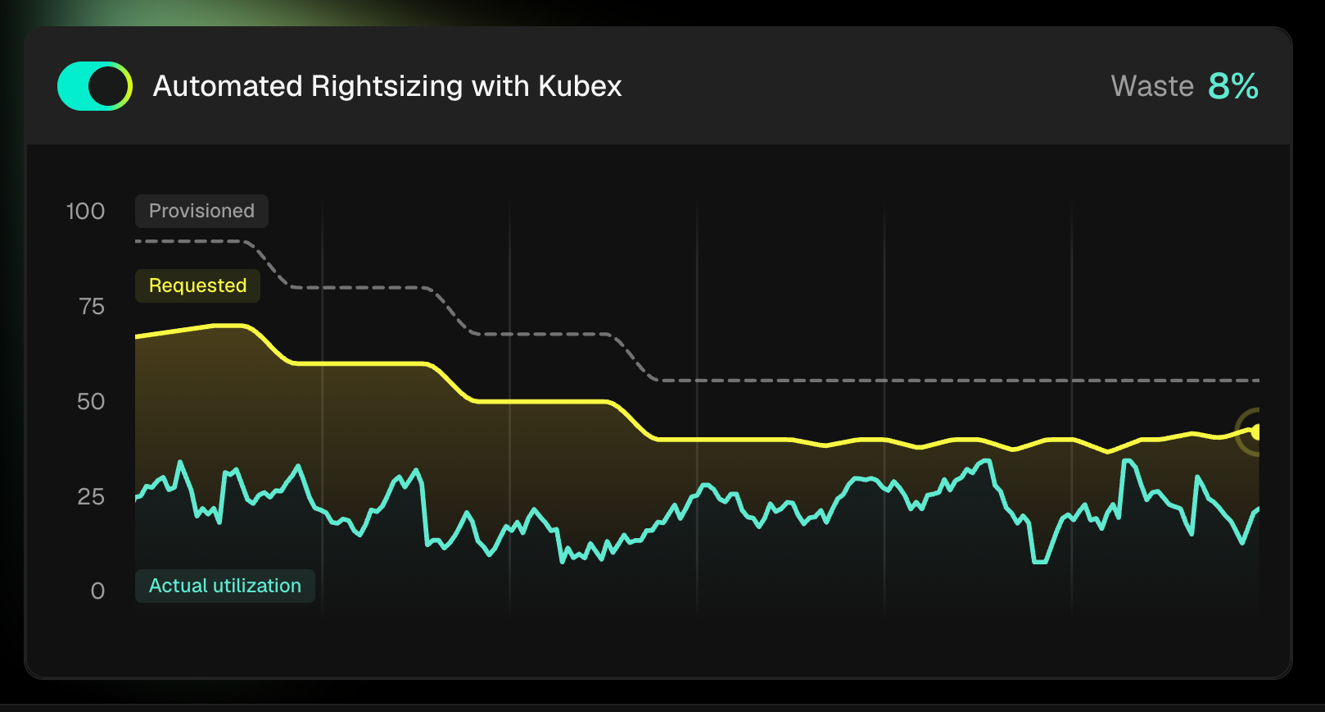
Kubex’s predictive pod scaler models a workload’s 24-hour usage pattern
to plan ahead of peak scaling.
GPU and AI infrastructure selection
GPU optimization splits into two questions that often get conflated.
- How to share the hardware already in the cluster?
- Is the workload running on the right GPU type in the first place?
Most platforms answer the first question, and the gap between the two is where the GPU budget can get wasted.
Sharing mechanisms are now table stakes. For example:
- NVIDIA’s Multi-Instance GPU (MIG) Partitioning splits one physical GPU into isolated fractions with dedicated memory
- Time-slicing interleaves workloads on a whole GPU
- MPS (Multi-Process Service) lets processes share GPU compute concurrently.
All four platforms address this layer in some form.
However, Kubex is the only one that also answers the type question. Its Catalog Map compares a workload’s requirements against GPU options across providers, including A100 MIG fractions, L4, B200, and Azure’s A10, with a cost justification for each candidate. An LLM running below 25% utilization on an A100 moved to an L4 for over 75% cost reduction, and the MIG reconfiguration path would have cost more than the instance change in that case. Sharing a GPU that the workload should not be on is still a waste.
The other three stay inside the sharing question.
Cast AI’s OMNI Compute approaches GPU scarcity as a supply problem and sources capacity across 125 regions with Spot management, time-slicing, and MIG support.
ScaleOps shares existing GPUs dynamically without MIG profiles to manage, a deliberate simplification that suits teams who have already committed to their hardware, and claims 50–70% cost reduction for early adopters.
Sedai’s GPU optimization (GA March 2026) deallocates idle GPU requests and repacks nodes for density. For sharing, it turns on MIG at the driver level, then uses Dynamic Resource Allocation (DRA), the Kubernetes-native API for requesting specialized hardware, to hand MIG slices to workloads.
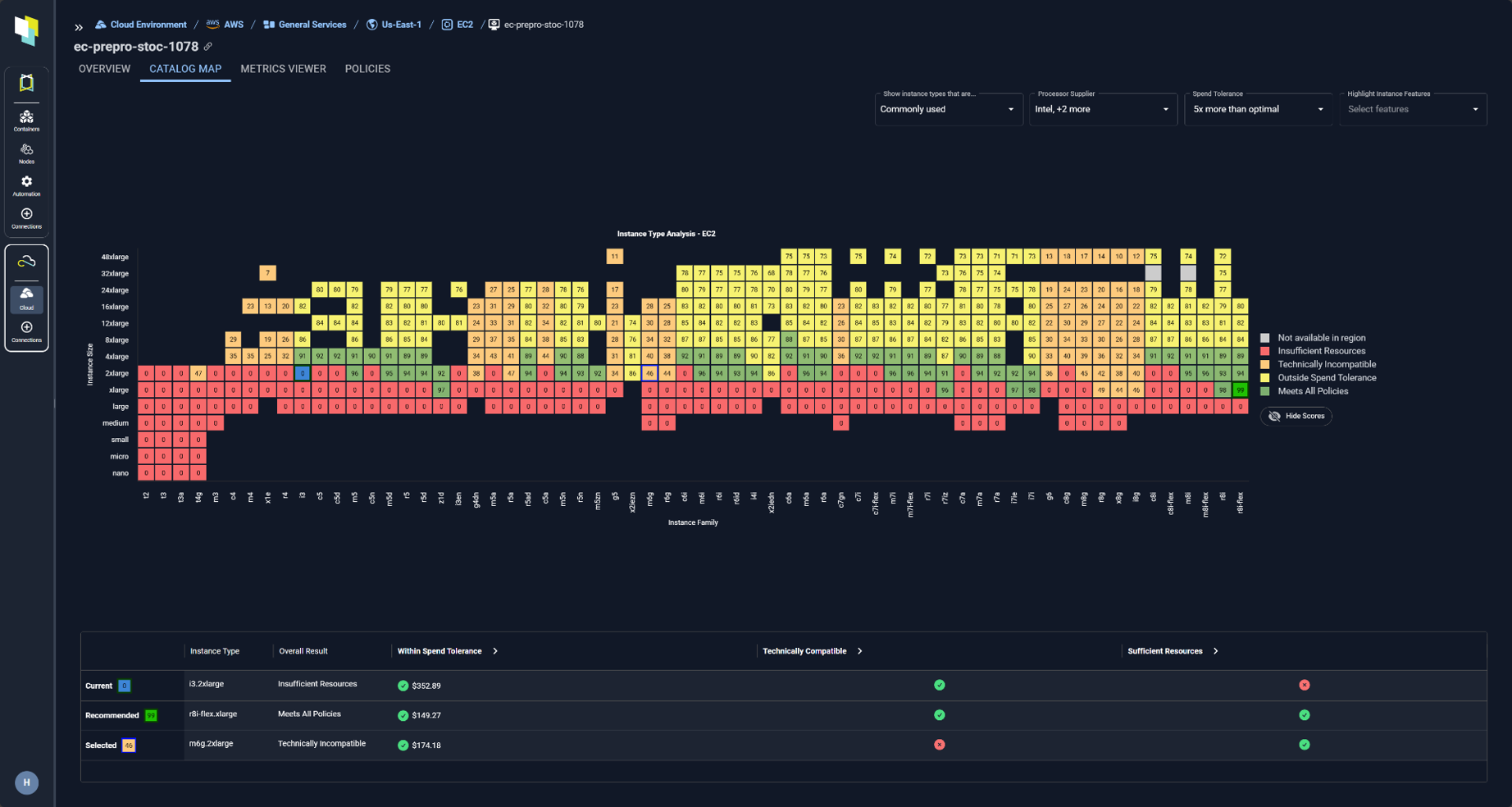
Kubex’s Catalog Map scores every GPU instance type against a workload’s requirements and color-codes them by fit and policy compliance.
Key insight: If the hardware decision is already committed and can’t change, the sharing-focused models from ScaleOps, Cast AI, and Sedai capture most of the available savings. If the GPU type decision hasn’t been made, only Kubex’s Catalog Map can guide you through the selection process.
Autoscaler architecture and lock-in risk
This is the decision that is most expensive to undo, because it determines who owns node provisioning for the life of the deployment. The four platforms take three distinct positions within the existing autoscaling stack:
- HPA and VPA (Vertical Pod Autoscaler) for pods
- Cluster Autoscaler or Karpenter for nodes
- KEDA for event-driven scaling.
Cast AI replaces Cluster Autoscaler. Its proprietary engine takes over the Cluster Autoscaler’s job, autonomously selecting instance types across Spot and on-demand pools, with a Spot interruption model that predicts the next hour on AWS and the next three hours on GCP. The automation is deep, and the results at the node layer are real. The trade-off is the exit: after a year in production, provisioning logic, instance selection policy, and Spot strategy all live inside Cast AI, so reverting means re-architecting how the cluster provisions capacity.
Kubex’s ML models analyze workload patterns and generate sizing recommendations, filtered by real-world impact and safety, so risky or low-value changes get screened out. At the same time, the execution layer remains whatever the team already runs, HPA, KEDA, or Karpenter, which Kubex integrates with for node decisions. Changes flow through Git-versioned manifests and ITSM tools (ServiceNow, Jira), so every optimization stays an auditable, reversible change record instead of an opaque runtime action.
The cost of governance is that Kubex does not implement node changes directly, which reduces risks, especially in production environments, compared to Cast AI for teams that want maximum hands-off automation.
ScaleOps and Sedai occupy middle positions. ScaleOps runs in-cluster beside the existing autoscalers and coordinates rightsizing with replica behavior. Its Smart Pod Placement steers workloads that PodDisruptionBudgets or safe-to-evict annotations pin in place, and can be deployed across more than 1,000 production clusters.
It works within existing scheduling constraints rather than around them, so a hard PDB, such as minAvailable set to the current replica count, still blocks the move. Sedai layers its Datapilot, Copilot, and Autopilot autonomy modes over the scaling stack without replacing any component.
Key insight: Accounts that need a rollback option after selecting a platform should weigh the risk of replacing their existing use of HPA, VPA, or Karpenter, before comparing products feature by feature. A missing feature would cost one or two calendar quarters of wait time, while the wrong architecture would require a full migration, jeopardizing application workloads.
Deployment model and data sovereignty
For some buyers, the deployment model is a preference. For others, it is a gate that ends the evaluation. Settle which case applies first, because it decides which platform survives the security review.
ScaleOps is fully self-hosted and runs entirely in-cluster with zero external dependencies, no data egress, full air-gapping support, and FIPS compatibility (the US federal cryptographic standard) for FedRAMP-certified environments as of December 2025. However, self-hosted tooling adds upgrade cycles, version drift, and capacity planning to the platform team’s backlog. ScaleOps Cloud adds a hosted control plane that applies RBAC policies globally, surfaces insights from all connected clusters, and maintains consistent resource management across environments. At the same time, workload data stays local to each cluster. Fully air-gapped deployments cannot use that hosted layer, so they must still operate cluster-by-cluster.
Kubex’s model sits at the other end of the hosting spectrum. A lightweight in-cluster agent collects telemetry and forwards it to analytics infrastructure on AWS, in a US or EU region of the customer’s choice. Every connected cluster appears on a single interface with centralized policy management. The per-cluster operational surface area remains small because the analytics burden falls on the vendor.
Cast AI and Sedai run comparable SaaS control planes, with Sedai’s spanning services well beyond Kubernetes.
Key insight: Ask whether in-cluster-only deployment is enforced by a security or legal review or chosen to reduce data egress. A mandate points to ScaleOps, while a preference opens the comparison to centralized SaaS models that cost less to operate per cluster.
AI interface and agentic extensibility
Every platform has AI features, so the useful distinction is architectural: is the AI a closed loop within a single product, or an optimization layer that external tools can call? The Model Context Protocol (MCP), the open standard for connecting AI agents to external systems, is what separates the two in practice.
MCP
Kubex pairs a conversational AI Agent with a published MCP server. The agent combines deterministic ML recommendations with a private LLM layer, so optimization decisions stay deterministic while engineers query them in natural language.
The MCP server can extend the same optimization data to agent frameworks your team already runs, including Claude, ChatGPT, Cursor, and Gemini CLI. You can turn Kubex into a callable layer within existing automation pipelines, rather than a chat window within a single UI.
AI SRE Agent
ScaleOps’ AI SRE Agent (GA March 2026) connects to live clusters, investigates workloads, ranks optimization opportunities by cost impact, and executes approved changes with a human in the loop, operating read-only by default and working in air-gapped environments. However, ScaleOps has not published an MCP server or any documented path for external agent frameworks to consume its optimization layer.
Application performance automation
Cast AI’s APA ships four prebuilt runbooks that generate pull requests for anticipated scenarios. Runbooks are scripted sequences, dependable for the cases they cover but inapplicable to those they do not.
AI agent optimization
Sedai’s AI Agent Optimization launch (early access, June 2026) optimizes the cost and routing of a customer’s own LLM and agent traffic, which is a product for AI workloads rather than an interface to Sedai. The optimization engine itself remains a closed reinforcement-learning loop, with no conversational interface or MCP server documented in public as of July 2026.
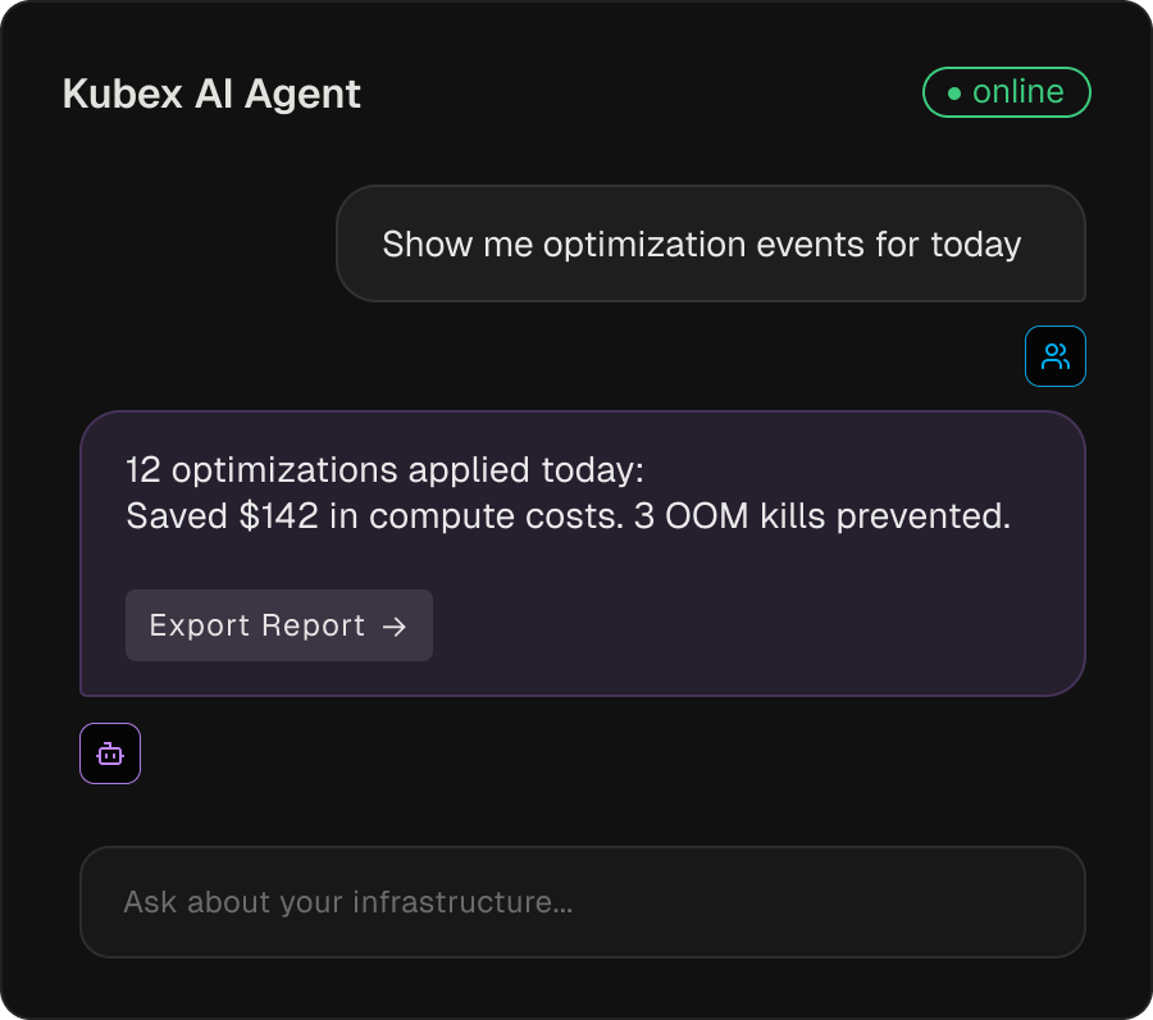
Kubex’s AI Agent answers natural language questions about optimization events directly in chat.
Platform scope, compliance, and pricing
These are important final considerations when making a choice.
Scope
Sedai is the broadest, covering Lambda, EC2, RDS, Databricks, BigQuery, and Kubernetes under one roof, which suits an SRE organization optimizing a mixed cloud estate with one vendor.
Kubex covers Kubernetes and cloud resources (EC2, RDS, and autoscaling groups) across AWS, Azure, GCP, and Oracle Cloud, keeping the center of gravity on Kubernetes while also managing the resources around it.
Cast AI and ScaleOps stay Kubernetes-scoped, so the choice reduces to a rule: breadth is overhead when the problem is Kubernetes-only, but becomes a benefit otherwise.
Compliance
Compliance positions differ enough to change procurement outcomes.
Kubex holds SOC 2 Type II certification, with ITSM integration producing the change records that vendor risk teams ask for, though it does not hold an independent ISO 27001 certification.
Cast AI holds both ISO 27001 and SOC 2 Type II, while Sedai holds SOC 2 Type 2.
ScaleOps relies on architecture-led compliance, arguing that self-hosted deployment removes the data-sharing risk certifications address, and lists no SOC 2 as of July 2026. That argument can carry in FIPS-first government environments and stall in sectors where vendor assessments require the certificate regardless of architecture.
Pricing
Pricing models shape total cost differently at scale:
| Platform | Pricing model |
| Cast AI | Marketplace pricing pairs a plan fee with usage-based billing. Growth tier: $1,000/month for up to 500 managed CPUs across four clusters; each managed CPU bills hourly at $0.00694 (about $5/month at full utilization). A 1,000-CPU estate requires a higher tier, and the bill is based on hourly CPU count rather than a flat rate. |
| Sedai | Enterprise pricing runs through AWS Marketplace private offers on annual contracts. No public tier pricing as of July 2026, beyond a $1 proof-of-concept offer; budget numbers come from the sales process. |
| Kubex | Usage-based pricing at $1/vCPU/month for Kubernetes and cloud optimization, with per-GPU pricing on the enterprise tier and the first 60 days free. The published per-unit rate makes cost modeling easy as the estate grows. |
| ScaleOps | Does not publish pricing; evaluation is demo-gated. |
Key insight: It’s not intuitive to determine the full cost from the pricing page alone. Take the time to calculate the pricing for the full scope of your test and production environments before implementing. Also consider the costs of vendor lock-in into proprietary technologies and switching costs of redefining your approach to autoscaling, if necessary.
Which platform fits your environment
Follow the bottleneck.
If waste concentrates in workloads with predictable cycles, scheduled batch processing, or AI training runs, Kubex’s predictive plans provision for the known shape before it arrives, and its Catalog Map covers the GPU-type decision that none of the others attempt.
If the pain is irregular, high-churn services, ScaleOps’ real-time adjustment converges fastest, and its self-hosted architecture clears sovereignty gates that the SaaS platforms cannot.
If node cost is the dominant line item and the team accepts ceding provisioning control, Cast AI automates that layer more deeply than anyone.
If Kubernetes is one estate among many, Sedai’s breadth consolidates vendors.
Two critical questions to consider:
- How expensive is the exit?
- Does procurement mandate self-hosting, or merely prefer it?
The through-line is reversibility. Advisory models like Kubex’s unwind by reverting Git-versioned manifests, while replacement models rebuild provisioning.
Optimization platforms earn trust by being adoptable in stages and removable without surgery, and by offering recommendations that a team can audit, apply, and unwind cheaply. This carries a lower structural risk than architectures that take ownership of the cluster. Whichever bet matches your bottleneck, prefer the version of it you can undo.
Cast AI is good at what it advertises: achieving savings quickly, automating aggressively, and handling Kubernetes cost optimization with minimal hand-holding. It’s a good choice for a team that wants a tool that drives cost optimization independently.
The challenges lie in the lack of control. The Cast AI node autoscaler replaces the standard components that add and remove nodes, such as the Cluster Autoscaler or Karpenter, the open-source node provisioner that AWS maintains. On EKS, Cast AI offers a second mode, the Karpenter Enterprise Suite, which manages Karpenter rather than replacing it. The two modes are mutually exclusive: you run either the Cast AI autoscaler or Karpenter with the Enterprise Suite, not both. Either way, Cast AI owns the node-provisioning layer, and that control cannot be toggled off.
Kubex, an alternative to Cast AI, uses a different architecture. It complements the autoscalers you already run rather than owning the provisioning layer itself, avoiding vendor lock-in and allowing you to choose best-in-breed solutions at every layer of the software stack.
In this article, we compare Cast AI to Kubex, not to declare a winner, but to explain the trade-offs for teams considering an alternative to Cast AI.
Kubex vs. Cast AI summary comparison
| Capability | Kubex | Cast AI |
| Autoscaler architecture and vendor lock-in risk | Enhances the autoscalers you already run instead of replacing them, so leaving is a configuration change. | Takes over node provisioning for deeper automation, so leaving means rebuilding how your nodes get provisioned. |
| GPU and AI workload selection | Compares GPU types side by side before you commit, which fits teams still choosing their hardware. | Runs the hardware you already committed to as cheaply as possible across 125 regions. |
| Agentic interface | A conversational agent answers questions and handles edge cases that nobody scripted in advance. | Four fixed automations that are fast and predictable for the scenarios they cover. |
| Node execution and stateful workloads | Prepares capacity before predictable traffic spikes but never touches the nodes themselves. | Acts directly on nodes and can move running workloads, including databases, between nodes without downtime. |
| Change governance | Flexible API supports integration with ITSM products like Jira or ServiceNow, or with GitOps pipelines. | Fits teams that approve infrastructure changes through GitHub pull requests. |
| Pricing model | Publishes its price per virtual CPU under management, so the cost can be modeled before signing. | No public rate, so budgeting waits on a sales quote. |
How to evaluate a Cast AI alternative
If you are weighing a Cast AI alternative, six criteria are where the differences show up: autoscaler architecture and vendor lock-in risk, GPU and AI workload selection, the agentic interface, node execution and stateful workloads, change governance, and pricing. Comparing Kubex to Cast AI across these dimensions surfaces a clear split, with Kubex the better fit for some and Cast AI for others. The sections that follow work through each one in order, starting with autoscaler architecture and vendor lock-in risk.
Autoscaler architecture and vendor lock-in risk
Most Kubernetes teams start with an open-source autoscaler. Cluster Autoscaler is the usual pick when the cloud does not support Karpenter, when staying cloud agnostic matters, or when the team has already invested in it; otherwise, Karpenter is the stronger default. When cloud spend grows large enough that provisioning decisions matter at scale, a commercial optimization layer becomes worth evaluating. This is where the two products split first, and where the split costs the most to undo: one replaces the machinery, the other advises it.
Cast AI replaces the provisioning layer
Cast AI replaces the Kubernetes Cluster Autoscaler entirely, so its own engine provisions nodes, selects instance types, and manages the fallback to spot instances (the discounted capacity a cloud provider can reclaim at short notice). The savings are real, but so is the dependency. After 12 months in production, removing Cast AI means rearchitecting node provisioning, not reverting a config file. That is vendor lock-in in the practical sense.
There is a partial middle path in Cast AI for Karpenter, available on EKS, which layers optimization on top of Karpenter without replacing it. It avoids the full-replacement model, but switching to the complete Cast AI Autoscaler later requires a full cluster re-onboard, and running both modes at once is not supported. An off-ramp exists, but it narrows the moment you commit to the full product.
Kubex complements the autoscalers you already know and trust
Kubex works alongside the Horizontal Pod Autoscaler (HPA, which scales replica counts), KEDA (its event-driven counterpart with scale-to-zero support), and Karpenter without replacing any of them. It rightsizes the underlying pod template, allowing pod and node autoscalers to scale efficiently and without waste. Platform teams keep full ownership of the provisioning layer, which matters in environments with ticket-gated ITIL change management, multi-team cluster governance, or contracts that require infrastructure auditability.
The consequence shows up at exit time. Removing Kubex means turning off recommendations, not rebuilding how nodes get provisioned. An application-level cost remains because Kubex tunes live workload requests, limits, and HPA targets over months, and turning it off reverts your workloads to their unoptimized state. Node-level lock-in is gone, but teams should plan to hand resource governance back to native tools like the Vertical Pod Autoscaler (VPA) or manual profiles to avoid drift. Enterprise procurement reviews still tend to identify autoscaler lock-in as the primary risk for regulated accounts moving from proof of concept to production.
Key insight: Cast AI’s replacement model buys deeper automation at the cost of a hard exit, while Kubex’s advisory model gives up some automation depth and keeps the provisioning layer yours. The right trade depends on how much you value being able to walk away.
GPU and AI workload selection
GPU spend raises two separate questions: where a committed workload can run most cheaply, and which GPU type fits the workload in the first place. Each tool answers one of them well.
Cast AI spreads workloads across regions
Cast AI’s OMNI Compute answers the placement question by providing GPU capacity across 125 regions with spot GPU management, automated fallback, time-slicing (sharing one GPU across several workloads), and utilization monitoring. For a team that has already chosen its hardware and needs to maximize utilization across regions, that case is directly covered. The GPU type is treated as fixed, and the job is to run it cheaply wherever capacity exists.
Cast AI also offers AI Enabler, an OpenAI-compatible LLM API that supports self-hosted model deployment on connected clusters. It routes each request to the lowest-cost model that still meets the SLA, evaluating the payload before it picks an endpoint. That is cost-aware selection across models and providers, not selection of the GPU type a workload should run on. The GPU hardware decision is a separate question, and the one the Catalog Map answers.
Kubex opens the hardware decision
Kubex’s Catalog Map answers the other question: Which GPU type should this workload use? It compares available options in a single pane, so MIG fractions of an A100 (partitions of NVIDIA’s data-center training card), the cheaper inference-focused L4, the top-end B200, and cross-provider choices like the mid-range Azure A10 sit side by side, each scored by technical fit and policy compliance. A team compares before committing rather than finding the mismatch on the invoice.
The trade-off is about where the savings live. An LLM running at low utilization on an A100 may belong on a cheaper card, and only a tool that compares types will say so. For teams with hardware already committed, OMNI Compute is the relevant capability, while for teams where GPU selection is still open, the Catalog Map is a richer decision surface that goes past cost-per-region.
Key insight: Both tools cut GPU waste, but Cast AI optimizes where committed hardware runs, while Kubex tells you when a different GPU would have been the better buy. If the hardware choice is still open, that second surface is where the larger savings sit.
Agentic interface and operational adaptability
Both products automate routine optimization and add an AI layer. They differ in how they handle work that doesn’t fit a script.
Cast AI runs prebuilt runbooks
Cast AI’s Application Performance Automation (APA) layer ships four runbooks that connect the optimization engine to a code repository through pull requests. The most useful one syncs workload autoscaler recommendations back into deployment manifests, narrowing the gap between what runs in production and what lives in source control. For a team already on GitOps, the practice where every configuration change flows through a Git repository, this is a concrete, repeatable workflow with version-controlled output.
The runbooks handle anticipated scenarios well, and they are fast and predictable for the cases they were written for. A scenario nobody wrote a runbook for is, by definition, out of scope until someone builds one.
Kubex covers the routine and the edge cases
Kubex includes a conversational AI agent and an MCP server—an interface built on the Model Context Protocol that lets external AI tools query the platform’s data. Platform engineers ask about cluster optimization in plain language, from routine sizing questions to situations that fall outside a static ML model. JVM-heavy applications, multi-tenant clusters with conflicting resource policies, and non-standard traffic patterns are the kinds of cases that do not map cleanly to a fixed rule.
The MCP server is the load-bearing component because it makes the optimization layer callable from outside the Kubex UI, enabling the data to feed the agent pipelines that the platform team already runs. Pre-built runbooks cover the expected path quickly, while an agent covers the novel case without waiting for a new runbook to be written first.
Key insight: The choice tracks how varied your workloads are: predictable patterns favor Cast AI’s runbooks, while a mix of unusual workloads favors an agent that handles cases nobody scripted in advance.
Autonomous node execution and stateful workload handling
This is where Cast AI’s depth is clearest and where Kubex solves a different problem rather than a smaller version of the same one: acting on nodes after demand arrives versus preparing them before it does.
Cast AI executes directly
Cast AI adds and removes nodes, selects instance types, and manages spot fallback without per-action operator approval. Container Live Migration, confirmed on GKE as of May 2026, extends this into stateful workloads, the ones with attached data that normally cannot move without an outage. Pods move between nodes without downtime, which removes the main risk of aggressive node consolidation for databases and stateful services. For teams that want maximum automation depth on stateless workloads, the execution model gets to outcomes faster at the node layer.
Kubex prepares before the spike
Kubex improves the accuracy of container resource requests, enabling Karpenter and the Cluster Autoscaler to make better scale-down decisions. The Node Pre-Warmer adds ML-based predictive pre-scaling for workloads with predictable traffic, such as batch jobs, AI training schedules, and nightly processing windows.
The two address different failure modes: Cast AI optimizes the node layer reactively and deeply, while Kubex targets scale events that require capacity to be ready before traffic arrives. For workloads with predictable traffic patterns, reactive scaling consistently lands too late, and pre-warming closes the cold-start gap.
Key insight: Cast AI suits teams that want the deepest automation on stateless workloads, with live migration covering the stateful case. Kubex suits teams whose peaks follow a cycle that reactive scaling cannot anticipate.
Change governance and audit workflows
Both tools serve compliance-sensitive environments, and both hold the certifications enterprise buyers ask for first. They record change through different systems, though, and the right one depends on where your team keeps its system of record.
Cast AI records through Git
Cast AI holds ISO 27001 and SOC 2 Type II, the two security audit certifications procurement teams usually request. Its audit log has a fixed 90-day retention window, with an open-source exporter for routing records to longer-term storage. The APA runbooks generate GitHub pull requests to update manifests, so changes stay version-controlled and traceable through the GitOps pipeline. For a team that treats GitHub as the system of record, that output drops straight into the existing review flow.
However, this can be a two-edged sword. For large environments or those with frequent change, GitOps integration can put app owners in “PR hell” as they have to approve a stream of Pull Requests for every minor change to a pod’s resource requests and limits.
Kubex records through ITSM
Kubex holds SOC 2 Type II. Changes are automated through in-place resizing and a Mutating Admission Webhook, meaning changes can be implemented quickly and without human intervention, either with or without Git repo write-back. This automation is highly configurable, meaning that only the workloads you want are optimized, according to your business rules.
Furthermore, its integrations with ServiceNow and Jira, the ticket-based change systems most operations teams run, support human-in-the-loop optimization using your existing ITSM workflows.. Compatibility with ArgoCD and Flux, the two main continuous deployment tools, prevents controllers from fighting over resource sizing.
The split is about the approval system of record, because a pull request and a Jira change ticket serve different governance models. Teams running GitOps-first with GitHub as the source of truth benefit from Cast AI’s PR-based output, while teams where platform and operations use ServiceNow or Jira as the approval gate benefit from Kubex’s ITSM path.
Key insight: Both tools produce a clean audit trail, so match the tool to where approvals already live: GitHub points to Cast AI, while ServiceNow or Jira points to Kubex.
Pricing structure and total cost of ownership
The two vendors disclose their rates in opposite ways.
Cast AI prices behind a sales call
Cast AI does not publish pricing, and its pricing page requires a sales conversation with no public tiers or rates. Reviews on G2 and AWS Marketplace point to a per-vCPU model, billed on each virtual CPU the platform manages, though the exact rate is not publicly confirmed. A per-vCPU model scales with compute consumption, which produces a compounding effect: as savings grow and the optimization engine runs on more compute, the tool’s own cost grows alongside it. That makes multi-year TCO harder to model before signing.
Kubex publishes its pricing model
In contrast to Cast AI, Kubex publishes a per-vCPU rate on its pricing page. That is a concrete difference a procurement team can act on: one number is public and can be modeled up front, the other requires a sales quote before terms are signed.
The procurement context decides how much this matters. In a short proof of concept, a usage-based model is easy to justify because the cost tracks directly to savings from day one. For enterprise procurement with legal review, the difference between a published rate and pricing that requires a sales quote is worth raising before commercial terms are finalized.
Key insight: A published rate can be modeled over a multi-year contract, while pricing that is not public cannot be, at least not until a quote arrives. Bring up the difference early, before commercial terms close.
Which platform fits your environment?
Neither tool is the right answer for every cluster because the fit follows the shape of the environment rather than a feature count.
Choose Cast AI if you want the deepest automation with the least hand-holding and if the replacement of your autoscaler is an acceptable price for it. It fits teams running GitOps-first with GitHub as the system of record, teams with committed GPU hardware that need utilization spread across regions, and stateless-heavy estates where live migration covers the stateful exceptions.
Choose Kubex if autoscaler lock-in is a risk your procurement review will not accept, and keeping the provisioning layer yours is non-negotiable. It is the stronger fit when spikes follow a known cycle, when the GPU type decision is still open, and the Catalog Map’s comparison beats placement alone. It is also a great choice when optimization data needs to feed external agent pipelines through MCP, or when ServiceNow or Jira is the approval system of record.
The autoscaler question is the one to settle first, because it decides most of the rest. A hard requirement to keep provisioning under your own control points to Kubex before any other criterion is weighed. Absent that, a stateless estate that values automation depth over exit flexibility tilts toward Cast AI.
Conclusion
The decision rarely comes down to a single missing feature; it comes down to how much control you are willing to hand over and how hard it would be to take it back. Cast AI replaces your autoscaler, automates deeply, and gets to savings fast, with the lock-in that follows from owning the provisioning layer. Kubex works next to your autoscaler, predicts load before it arrives, and stays removable at the provisioning layer, with the caveat that its tuned workload thresholds freeze at exit and need handing back to native tools.
The cleanest way to settle the question is to start from the constraint that does not move. If it’s important that walking away from the tool in two years be inexpensive, the evaluation will be quick. If it is not, run both against the hardest scenario in your environment—a known-cycle batch window or a regulated change rollout—and let the result decide rather than the datasheets.
Table of Contents

Try us
Experience automated K8s, GPU & AI workload resource optimization in action.
Get Started for Free


Get started with Kubex

Enter your email
Error: Contact form not found.
By signing up, you consent to the Terms of Service and Privacy Policy.
Need help? Contact Support